
June Research Roundup: Select Papers
In this month's edition of our research roundup, we highlight a new study on African air pollution; deep Earth carbon recycling; and a Pacific cooling mystery.
Each month, researchers from the Lamont-Doherty Earth Observatory and across the Columbia Climate School publish work that sharpens our understanding of the planet.
This month we wrote about new evidence from Antarctic ice cores suggesting that the Ross Ice Shelf and West Antarctic Ice Sheet were far smaller during the planet’s last major warm period; the solution to a longstanding atmospheric CO2 puzzle; and a “near-miss” tsunami in Alaska that was the second-highest ever recorded.
Here are additional studies by our researchers worth noting.
Desert Dust Could Blunt Some Health Gains From Cleaner Air in Africa
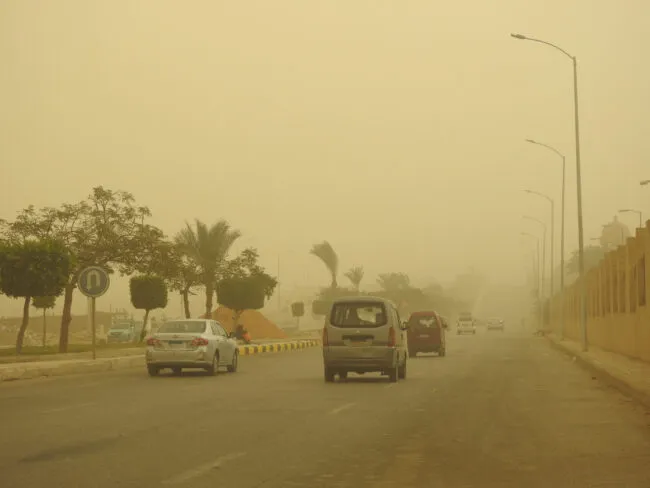
Cutting human-made soot and smog pollution could save many lives in Africa, according to a new study by Lamont researchers and colleagues. Using several different Earth system models, the team found that global cuts in fine particle emissions could prevent about 96,000 premature deaths a year in Africa by 2050; cuts within Africa alone could prevent about 84,000.
“The gains are not guaranteed everywhere, because changes in natural dust patterns, driven by climate, could cancel out some improvements in places where dust is already a major part of the air people breathe,” said first author Joe Adabouk Amooli, a graduate student in Columbia’s Department of Earth and Environmental Sciences.
Why it matters: Tiny airborne particles are one of the world’s deadliest forms of pollution. In Africa, the problem is especially complicated because dirty air comes not only from cars, industry, household cooking and fires, but also from desert dust. That means future health risks will depend both on pollution policy and on how climate change alters winds, rainfall and dust storms.
Other Columbia-affiliated authors: Joe Adabouk Amooli, Yanda Zhang and Daniel M. Westervelt, Lamont-Doherty Earth Observatory; Ron L. Miller and Kostas Tsigaridis, Center for Climate Systems Research.
How much carbon gets dragged
into Earth’s interior?
At subduction zones, seafloor sediments carrying the carbon-rich remains of marine life sink into Earth’s mantle. Some of this carbon may later surface through volcanic eruptions, and some may continue to sink into the deeper mantle and transform into diamond. Geochemist Terry Plank and marine geophysicist Alberto Malinverno met for over a decade in their Lamont offices to calculate the most detailed estimate yet of sedimentary carbon entering the world’s trenches. Their study finds that the global sedimentary carbon flux may be less than half some previous estimates, and that carbon removal varies sharply from one subduction margin to another.
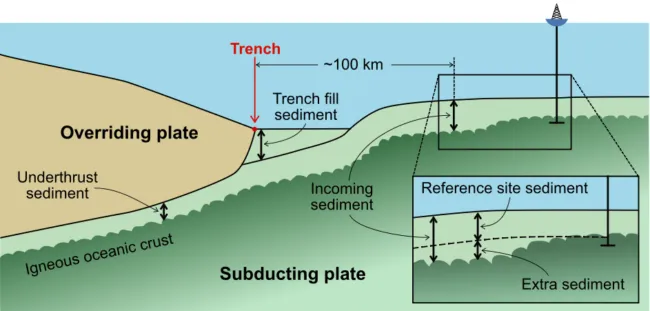
“Subduction zones are one of the main ways Earth recycles carbon over geologic time,” said Plank. “What surprised us is how uneven that recycling is from one margin to another, and how clearly the sediments going in can leave chemical fingerprints in the volcanic gases coming out.”
Why it matters: Carbon moving through subduction zones is a small part of the short-term carbon cycle, but over millions of years it helps regulate the balance of carbon between Earth’s surface, atmosphere and deep interior. The study also shows that the carbon isotope signature of volcanic gases can reflect the sediments being recycled beneath nearby volcanoes, giving scientists a clearer view of how surface carbon moves through Earth’s deep interior.
Columbia-affiliated authors: Terry Plank and Alberto Malinverno, Lamont-Doherty Earth Observatory.
A Pacific cooling mystery may be harder to solve than it looks
For decades, the eastern tropical Pacific has not warmed the way many climate models say it should. In fact, a narrow band of surface waters known as the Pacific cold tongue has cooled, even as most of the rest of the planet has warmed. A new study by Lamont climate scientists examines one widely used ocean dataset that blends observations with model outputs. They found that its apparent agreement with the observed cooling may depend heavily on an added correction, rather than on the model’s own representation of ocean physics.
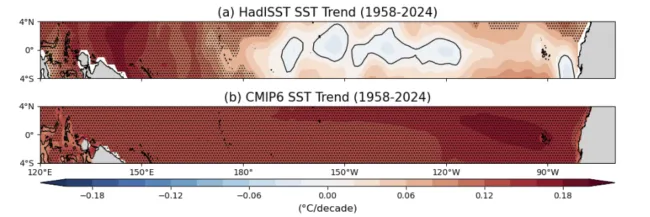
“The eastern Pacific cold tongue is one of the places where observations and climate models still do not line up,” said Feng Jiang, a Lamont postdoctoral research scientist. “Our study shows that even reanalysis data need to be handled carefully. They may reproduce the cooling, but not necessarily by capturing the physical processes that caused it.”
Why it matters: The tropical Pacific helps shape weather and climate far beyond the ocean basin, influencing rainfall, drought, El Niño behavior and estimates of future warming. If models and reanalyses are getting the right surface pattern for the wrong reasons, scientists still have work to do before they can say with confidence why the cold tongue has cooled, or what it will do next.
Columbia-affiliated authors: Feng Jiang, Richard Seager and Mark A. Cane, Lamont-Doherty Earth Observatory.
Other New Papers
How future sea-level change could reshape Greenland’s coasts
Impacts of future sea-level change on Greenland from community knowledge, coastal mapping and glacial isostatic adjustment models
What the Aleutian arc can tell us about how continental crust forms
Along-strike seismic structure of the Andreanof Aleutian Arc Segment and implications for the formation of continental crust; news story here.
Reading Arctic Ocean history through ancient microbial fat molecules
Towards understanding archaeal lipid biomarker (GDGT) distributions in central Arctic Ocean sediments