
Pacific Ocean Pattern Helps Explain Diverging Wildfire Trends in U.S. and Australia
Two of the world’s most fire-prone regions have followed strikingly different wildfire trajectories despite both experiencing a warming climate.
Highlights
- Wildfire trends have moved in different directions in the U.S. Southwest and eastern Australia, even as both regions have warmed.
- The study found that warming has made the air drier in both places, which can make forests more likely to burn.
- A long-term shift in tropical Pacific sea-surface temperatures appears to have made fire conditions worse in the U.S. Southwest, while easing some of the pressure in eastern Australia.
- The findings suggest future fire risk will depend not just on rising temperatures, but also on how Pacific patterns, including El Niño and La Niña, change over time.
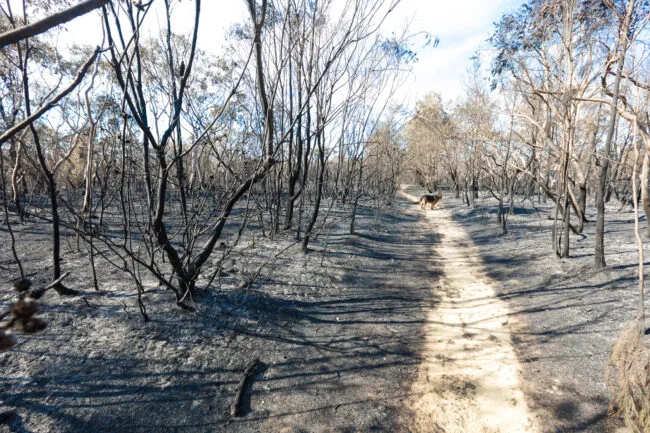
Two of the world’s most fire-prone regions have followed strikingly different wildfire trajectories despite both experiencing a warming climate. Burned forest area has surged across the U.S. Southwest, while eastern Australia has not seen the same increase.
A recent study published in Environmental Research Letters indicates that a decades-long shift in the tropical Pacific Ocean contributed to these contrasting trends.
“We found that what’s happening in the tropical Pacific over longer timescales, not just during El Niño and La Niña, is another significant piece of the puzzle,” said lead author Tess Wei-Ping Jacobson, a postdoctoral fellow at NASA Goddard Institute of Space Studies and recent Ph.D. at the Lamont-Doherty Earth Observatory, which is part of the Columbia Climate School.
El Niño and La Niña are among the best-known examples of Pacific climate variability, influencing weather and wildfire risk around the Pacific over periods ranging from months to a few years.
The researchers examined an observed multidecadal trend in the tropical Pacific Ocean that has persisted since the 1980s, in which the western tropical Pacific has warmed faster than the eastern Pacific. They then studied how this trend influenced atmospheric dryness and, in turn, burned forest area in the U.S. Southwest and eastern Australia.
How a Pacific Ocean Shift Changed Fire Conditions
The researchers analyzed burned forest area and climate records across the southwestern U.S. and eastern Australia from 1984 to 2022, combining observations with a large ensemble of climate model simulations. They focused on vapor pressure deficit, a measure of atmospheric dryness—how strongly the atmosphere pulls moisture from plants and soil—and one of the strongest predictors of year-to-year burned forest area.
Using statistical attribution methods, they first estimated the relative contributions of human-caused warming and the long-term Pacific trend to the observed increase in atmospheric dryness. They then quantified how those changes translated into burned forest area.
Atmospheric dryness increased in both regions during the study period, with human-caused warming accounting for most of that increase. The Pacific trend influenced the extent of additional drying each region experienced.
Across the U.S. Southwest, burned forest area increased sharply during the study period: by more than 3,000% in the interior Southwest and more than 1,000% in a coastal region that includes much of California. Most of the increase linked to rising atmospheric dryness was driven by human-caused warming, but the long-term Pacific trend added to it, contributing an additional 22% to the drying-related increase in burned forest area.
In eastern Australia, the Pacific trend reduced drying relative to what would otherwise have occurred due to warming alone. The researchers estimate that this reduction in atmospheric dryness corresponded to about a 19% reduction in burned forest area relative to what would otherwise have occurred in the two eastern Australian subregions they analyzed.
Unlike in the U.S. Southwest, the analysis suggested a downward trend in burned forest area in eastern Australia, but the evidence wasn’t strong enough to conclude that a long-term decline had occurred. The findings suggest that the Pacific trend moderated the climate change-driven tendency toward increasing burned forest area. Atmospheric dryness nevertheless increased during the study period, indicating that the Pacific shift dampened rather than reversed the effects of warming.
Why the Pacific’s Future Matters
The findings also highlight an important uncertainty. Current climate models predict that the tropical Pacific will evolve differently as greenhouse gases rise. Instead of the western portion continuing to warm faster than the east, as has been observed in recent decades, climate models project that the temperature difference between the two Pacific regions will shrink. Whether the observed Pacific trend reflects natural variability, a response to greenhouse warming, or some combination of the two remains an open question.
Even with this uncertainty, the findings suggest future wildfire risk in both regions will depend not only on continued human-caused warming, but also on how the tropical Pacific evolves over the coming decades.
Jacobson noted that while year-to-year El Niño and La Niña events are closely monitored, the slower changes in the tropical Pacific have received far less attention as drivers of fire activity—and this has practical implications. For example, Australia and the U.S. share firefighting resources through an international partnership made possible in part by their historically offset fire seasons, although the overlap between those fire seasons has already begun to increase. A better understanding of those longer-term Pacific changes could help both countries plan for future wildfire risk.
The study was coauthored by Richard Seager and Caroline S. Juang, Lamont-Doherty Earth Observatory; Benjamin I. Cook, NASA Goddard Institute for Space Studies; and Hamish Clarke, the University of Melbourne.