
Climate Scientist Marco Tedesco Examines What Responsible AI Could Look Like
The Lamont-Doherty Earth Observatory researcher is helping launch an AI working group to explore how AI can support climate research without undermining ethics, equity or scientific judgment.
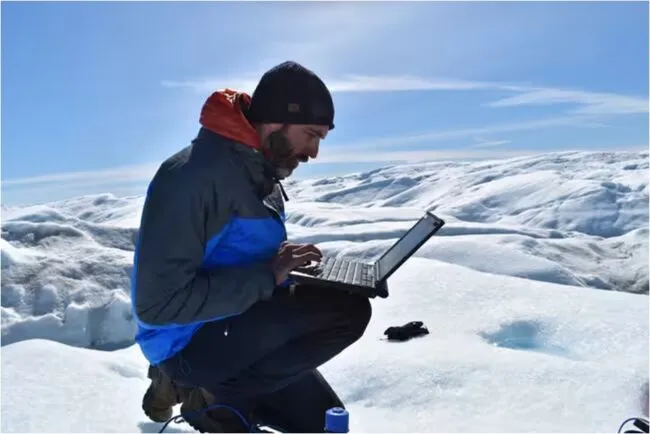
Marco Tedesco does not sound like a man trying to sell artificial intelligence.
He does not describe it as a revolution that will save science, nor does he dismiss it as a fad. Despite having worked with artificial intelligence since the late 1990s, he remains cautious about the optimism surrounding the technology.
For Tedesco, a research professor at the Lamont-Doherty Earth Observatory, which is part of the Columbia Climate School, AI is already inside the room. The question is no longer whether researchers should engage with it, but whether they can do so without surrendering their judgment, ethics or curiosity.
“The problem is not whether AI is going to be here,” said Tedesco. “AI is already here. The problem is how we are going to use it, and how we are going to continue building it.”
That concern is shaping an emerging effort at Lamont to think more deliberately about artificial intelligence—not simply as a tool for accelerating academic work, but as a force that could alter how science is done, who benefits from it, and what costs remain hidden.
About a year ago, Tedesco approached Lamont leadership about creating an AI working group. He believed the institution needed shared space to examine AI critically, rather than treating it only as a convenience or a threat.
“I felt that we were missing the opportunity to create some of the science that can be created here at Lamont using AI,” he said, “and to adopt AI critically, rather than just either ignoring the existence of AI or accusing AI of being the greatest evil.”
Tedesco is neither an evangelist nor a conventional skeptic. He sees AI as a tool, but one shaped by the economic, political and environmental systems that produce it.
“To me, AI can be a manifestation of evil,” he said, “but it is not evil itself.”
Historic pivot
For Lamont, he said, AI may represent a turning point comparable to earlier technologies that reshaped Earth science, from radar to sensors and computers. Some of those technologies came from military or industrial contexts before being adapted for scientific use. AI may follow a similar path, offering researchers new ways to process information, identify patterns and test ideas.
But this time, he argues, scientists cannot afford to separate technological possibility from social consequence.
Pavithra Priyadarshini Selvakumar, a postdoctoral research scientist at Columbia Climate School and Lamont-Doherty Earth Observatory, said Tedesco’s work is distinctive because of his willingness to push across disciplinary boundaries. Through the AI working group, AI Foundation 101, the AI Symposium and related initiatives, she said, he is helping create spaces where researchers can examine AI through ethics, mental health, neuroscience, communities, climate science, gender and data science.
“It shows that these issues are not separate, but deeply connected,” Selvakumar explained. “He is actively creating spaces where people can come together, learn, question and think differently.”
For Selvakumar, that kind of interdisciplinary work takes courage, especially in a field like AI, where there can be both excitement and skepticism. She said Tedesco’s approach helps break down hesitation by showing that questions about technology, equity, climate and society belong in the same conversation.
The promise of AI is real. Tedesco offered the example of using satellite data from the Moderate Resolution Imaging Spectroradiometer or Landsat to detect a signal over a particular area—a plume, perhaps, or a toxic material. An AI tool can draft code for Google Earth Engine, allowing a researcher to produce a preliminary time series far faster than before.
In his view, AI may assist with coding, synthesis and calculation. It may help researchers identify patterns or build a first draft of an analysis. But the scientific question—deciding what matters, what to test, and how to interpret it—still belongs to the human behind it.
“The question is no longer whether researchers should engage with [AI], but whether they can do so without surrendering their judgment, ethics or curiosity.”
That belief fuels Tedesco’s belief in the AI working group. The goal is not merely to make Lamont better at using AI. It is to keep researchers from becoming passive users of systems they do not understand.
The concerns extend beyond the scientific method. Tedesco worries about training data, embedded values, transparency and the physical infrastructure behind AI systems, including data centers that require electricity, cooling and land. As demand grows, those systems can place new pressure on electric grids and local communities, while the benefits may flow disproportionately to technology companies.
Selvakumar said that is why questions of gender, equity and community impact cannot be added later. AI systems, she said, are shaped by the same structural privileges and inequalities that exist around us. Climate change already affects people unequally, and AI can either help address those inequalities or reproduce them in new forms.
When women, gender-diverse people and frontline communities are missing from datasets or design processes, she said, AI tools can make already marginalized communities even more invisible. In climate work, that can affect which risks are recognized, whose knowledge counts and whose needs are prioritized. At worst, she said, it can become a form of digital colonialism, in which technologies are used to make decisions about communities without meaningful participation from those communities.
Climate versus society?
For scientists concerned with climate and society, this creates an uncomfortable contradiction. A researcher might use AI to study the environmental footprint of data centers while relying on the same infrastructure that produces that footprint. Someone may want a more transparent, lower-impact or ethically governed model, but they have few practical choices.
Tedesco sees that lack of choice as one of the most troubling parts of the current AI landscape. In other areas of life, he noted, people can at least try to direct their money, labor or attention toward systems they see as more equitable. With AI, the options are far more limited. The result, he said, is a technology that risks reinforcing power in the hands of a small number of companies and individuals.
Against that backdrop, the Lamont AI working group is a modest but important intervention. It will not solve the environmental cost of data centers or the political economy of Silicon Valley. But it can create a place where researchers ask sharper questions before folding AI into scientific practice.
“I am glad that Marco has taken this important initiative to build an interdisciplinary space at the intersection of AI, climate and society at Columbia,” said David Sathuluri, founder and co-director of Lamont’s Laboratory of AI, Climate and Society. “This work is especially urgent right now, as AI is shaping our lives from every direction, and we need real checks and balances to ensure it is used ethically.”
For Tedesco, training younger researchers is central. Students are entering professional life when AI tools are both useful and morally complicated. These tools can help with coding, writing, analysis, and career advancement, but they can also create dependency, blur authorship and weaken the habits of thinking students are still trying to build.
His advice is not to avoid AI, but to use it with guardrails.
“The greatest danger,” Tedesco said, “is that you become a tool for AI rather than AI becoming a tool for you.”
Tedesco imagines Lamont as a flexible space where researchers, students and staff can examine AI across disciplines, test its uses and study its consequences. The ambition is broad because the problem is broader. Climate touches health, jobs, land use, inequality, infrastructure and ethics. AI increasingly does the same.
For an Earth science institution, that overlap is not incidental. A technology that promises to help analyze the planet may also consume its resources, reshape its labor systems and reproduce its injustices.
That is why Tedesco wants the conversation to begin before habits harden.
Vishal Manve works at Lamont-Doherty Earth Observatory, which is part of the Columbia Climate School, and is a graduate of the Columbia Climate School. He helped organize Lamont’s AI Working Group Symposium and is interested in the intersections of climate science, AI Policy, equity and public communication.