
Long-Term Study Suggests Landfill Methane Emissions Are Far Higher Than Estimates
Highlights
- Researchers tracked methane emissions from a major New Jersey landfill for more than two years.
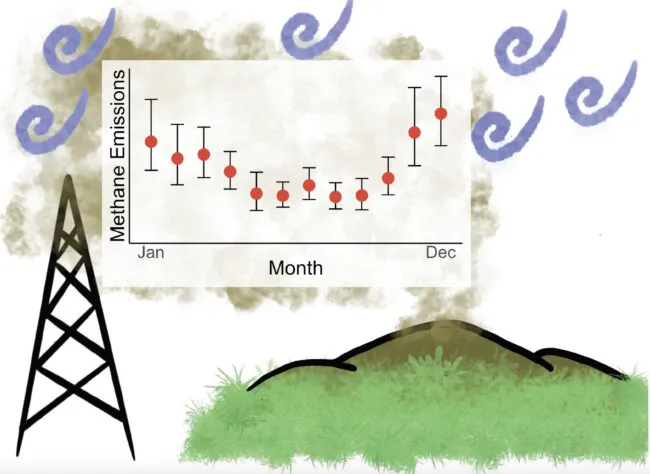
- Emissions were highest in winter and lowest in summer, with cold temperatures and falling air pressure linked to larger releases.
- The landfill emitted about five times more methane in 2023 than was reported to the U.S. Environmental Protection Agency.
- The findings suggest that short-term or “fair-weather” surveys may miss major landfill methane releases.
Methane is an especially potent greenhouse gas, causing much more warming than carbon dioxide on a unit-for-unit basis—and a new, uniquely long-term study of emissions at a New Jersey landfill suggests that estimates of methane pollution in the U.S. and elsewhere may be dramatically off. The study, published by researchers at Lamont-Doherty Earth Observatory, which is part of the Columbia Climate School, used continuous ground-based measurements to determine that landfill methane emissions are likely much higher than current estimates.
Methane’s potency is caused by the geometric structure of its molecules, which allows them to absorb more infrared light—and thus become hotter—than does carbon dioxide (CO2). One ton of methane has the warming potential of about 28 tons of CO2; in 2022, the most recent year for which official U.S. emissions data exist, methane accounted for roughly 12 percent of the country’s greenhouse gas emissions. A similar proportion applies to global emissions. Landfills, where decomposing organic waste feeds methane-generating microbes, are responsible for an estimated 17 percent of U.S. methane emissions.
The primary method used by the U.S. Environmental Protection Agency (EPA) to calculate landfill methane emissions projects emissions based on a landfill’s total waste, adjusted to account for gas captured onsite. Another method extrapolates whole-landfill emissions from those gas-capture readings. But measurements of whole-landfill emissions, such as from methane-detecting satellite imagery or aircraft, suggest that actual emissions are higher than the EPA estimates.
“If you take all of the evidence, it’s pretty clear that the EPA estimates are too low,” says Lamont researcher Andrew Hallward-Driemeier, a PhD candidate in Earth and Environmental Sciences and lead author of the study, which appears in the journal Environmental Science & Technology.
The satellite and aircraft methods have their own limitations: Satellites can be blocked by clouds or confused by water vapor—a problem when landfills are located in or near wetlands—and both methods provide only snapshots of emissions. Meanwhile, ground-level measurements sample small areas and are prone to missing methane-generating hotspots.
What’s been lacking is fine-grained, long-term data. “We wanted to come up with a methodology that uses continuous measurements to give year-round estimates of emissions,” says Hallward-Driemeier.
To do this, the researchers developed a method to estimate emissions using two-and-a-half years of methane readings from atop a Rutgers University–operated tower near a landfill in East Brunswick, New Jersey.
Estimated emissions from this novel methodology agreed with snapshots of emissions detected by two separate aircraft overflights. But the long-term data provided much more information to understand the drivers of methane emissions at the landfill.
“We were able to see what’s going on over much longer time scales than others have been able to,” says Róisín Commane, a researcher at Lamont and an associate professor of Earth and Environmental Sciences.
“I would be careful in saying how widespread these results might be when we haven’t been able to do it on other landfills yet. It’s a good reason to apply this method near other large landfills.”
Róisín Commane, Lamont-Doherty Earth Observatory
The researchers found strong seasonal differences in emissions, which peaked in early winter—something that aircraft measurements would tend to miss, says Hallward-Driemeier, because those are usually collected in summer. He and his colleagues think that cold temperatures cause methane-consuming microbes in the soil atop landfills to go dormant, even as methane continues to be generated by bacteria still active in a landfill’s warm depths.
Atmospheric low-pressure systems also produced increases in methane emissions, likely by making it easier for gases to escape into the atmosphere. Earlier research had identified low-pressure conditions as important, but the new findings underscore just how important they may be. Low-pressure systems can also cause trouble for satellite and aerial methane measurements, as those systems tend to come with clouds.
Ultimately, the researchers found that the landfill’s emissions in 2023 were fully five times higher than had previously been estimated.
That figure isn’t necessarily applicable to every landfill, but it is emblematic of how current estimates may vary wildly from actual emissions. What’s applicable is the principle: Taking continuous, long-term measurements may produce a very different picture than scattered snapshot measurements and the rule-of-thumb conventions used today.
“I would be careful in saying how widespread these results might be when we haven’t been able to do it on other landfills yet,” says Commane. “It’s a good reason to apply this method near other large landfills.” This could be done inexpensively, she says, and would also help identify which landfills have methane problems and which do not.
In the meantime, the researchers encourage people measuring methane with standard methods to sample across multiple seasons, with special attention to those low-pressure conditions. They also suggest that landfill managers who operate gas-capture systems could increase pumping efforts at opportune times.
“You might have, on a high-pressure day, methane building up inside the landfill because it can’t get out. The pressure in the atmosphere is too high. Then it all escapes as the pressure drops,” says Hallward-Driemeier. “But if you knew that was about to happen, you could pump it out more efficiently in the time leading up to the pressure drop.”