
Massive Calving Episode in Greenland May Foreshadow More Rapid Ice Sheet Loss
Researchers studying a lake drainage event in Greenland determined that large amounts of meltwater can lead to massive glacier calving events and accelerate ice sheet loss.
Last November, a study led by Adrien Wehrlé, a researcher in the department of geography at the University of Zürich, Switzerland, looked at the massive calving response of one of West Greenland’s active glaciers, Sermeq Kujalleq in the Kangia icefjord (SKK), to the drainage of two surface lakes. Called supraglacial lakes, these are temporary meltwater ponds that form and accumulate in the depressions or holes on the surface of glaciers and ice sheets. Using satellite and terrestrial radar observations, the researchers studied the response of SKK to the drainage of two supraglacial lakes in July 2022.
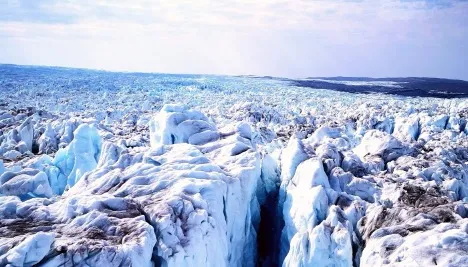
SKK, also known as the Jakobshavn glacier, is a large and rapidly retreating outlet glacier on the Greenland ice sheet. As one of the world’s fastest moving and most active ice streams located in West Greenland, it discharges more than 50 gigatons of ice into the ocean each year. Rising temperatures and increased melting will cause larger lakes that may increase the frequency and magnitude of drainage events, further degrading glaciers and contributing to sea level rise.
Between July 21 and 24, two supraglacial lakes located 13 km south of SKK and 25 km from the glacier’s edge released a catastrophic surge of fast-flowing meltwater that propagated all the way to the glacier’s lowest depths.
This unusual event is an example of a process chain from a lake drainage event to a resulting calving episode, demonstrating the influence that an increase in glacier flow upstream can have on Greenland tidewater glaciers at large. A drainage event sends a sudden pulse of meltwater to the bottom of the glacier, lubricating the glacier and resulting in a faster flow. Similar to a traffic jam suddenly clearing, this rapid flow pushes material forward and destabilizes the glacier edge. The stress from this acceleration forces open the pre-existing cracks at the glacier front, leading to a cascade of calving events.
In this case, the July rapid drainage event resulted in a subglacial flood at the base of the ice stream that lubricated the bottom of exit glaciers and rapidly accelerated ice flow. Though the regular flow speed of SKK is around 7 km per year, this acceleration created a surface speed-up pulse that travelled over 16 km downstream within four hours. This speed-up flow, equivalent to a walking pace of around 2.5 miles per hour, lasted for 24 hours and triggered a massive calving episode upon reaching the end of the glacier, or glacier terminus.
Unlike the calving events shown in movies that often depict a singular chunk of ice breaking and falling into the water below, this massive calving episode recorded 25 consecutive events over the span of two hours. The largest single calving event during this episode was also one of the largest of the 125 total calving events that the researchers captured during their 13-day field campaign in the SKK region.
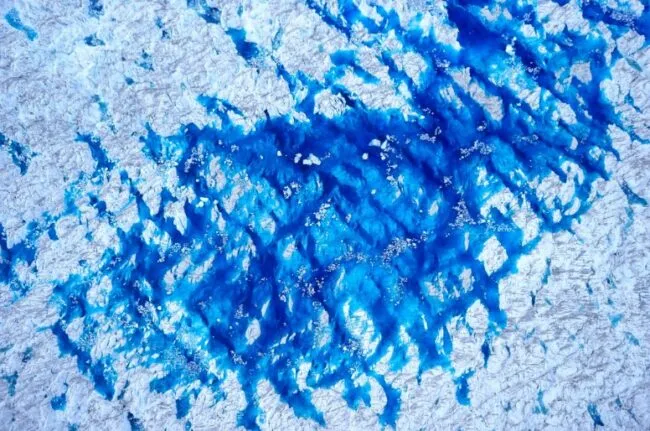
In the study, researchers were able to document a direct causal relationship between lake drainage and calving activity, concluding that disturbances from drainage events upstream can propagate downstream without dampening and directly impact calving events at the glacier terminus.
The Greenland ice sheet alone is responsible for 20% of current global sea level rise. Jonathan Kingslake, a glaciologist at Lamont-Doherty Earth Observatory, which is part of the Columbia Climate School, told GlacierHub that “while general statements about the frequency and magnitude of similar events may be hard to make, there is probably going to be more drainage and melting in the future.”
The rate of melting in Greenland, which is nearly seven times faster than it was 30 years ago, creates alarming risks for coastal communities that are highly vulnerable to destructive flooding events and saltwater intrusion. Arctic ice sheet loss may also destroy vital wildlife habitats and disrupt marine ecosystems in the region.
While there are no numerical estimates on how this process chain will affect total glacier loss, drainage and calving events may occur more frequently due to climate change. “There will generally be more melting on [glacier] surfaces where they’re in contact with the atmosphere, or at the sides where they’re in contact with the ocean,” Kingslake said. “The ocean is warming, so its warmer currents cause ice sheet loss as a secondary element.” As rising temperatures accelerate ice melt, the potential increase in massive calving events will only exacerbate the irreversible loss of the Greenland ice sheet.