
Carbon Dioxide and Water Played Key Roles in Historic Mount Etna Eruptions
Understanding these dynamics can help geologists assess the risk of future eruptions.
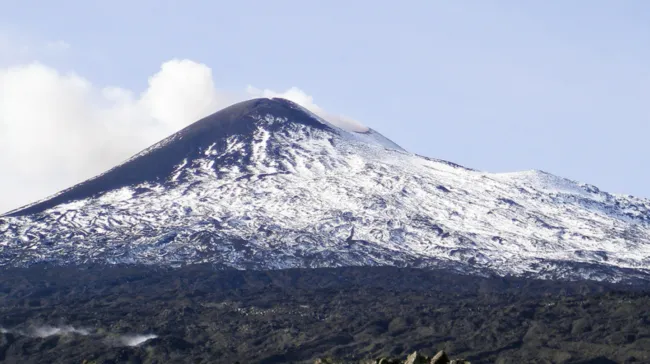
Highlights
- Scientists reconstructed the underground magma pathways behind two historic explosive eruptions of Mount Etna.
- The study suggests carbon dioxide and water helped drive the eruptions in different ways.
- In one eruption, water-rich magma rose and stalled at shallow depths before erupting; in another, carbon dioxide-rich magma rose quickly from much deeper underground.
- The findings could help improve physical models scientists use to understand volcanic hazards.
Adapted from a Cornell University press release written by David Nutt.
The plumbing systems of volcanoes are vast and complex. But they aren’t consistent, even within the same volcano.
A recent study found very different mechanisms behind two historic eruptions of Italy’s Mount Etna, one of the tallest active volcanoes in Europe. Understanding these dynamics can help geologists assess the risk of future eruptions.
The findings were published in Geochemistry, Geophysics, Geosystems. The research was led by Cornell University, with contributions from the Lamont-Doherty Earth Observatory, which is part of the Columbia Climate School. Lamont geochemist Terry Plank, a coauthor of the study, helped collect field samples from Mount Etna that the team used to reconstruct the volcano’s underground plumbing.
Explosivity is determined by a range of factors, from magma viscosity to the volatile gases that separate from magma as it rises.
“Imagine a bottle of soda. If you open that bottle without agitating it, you can drink it, but if you shake it up, all the bubbles get separated really fast, and you have an explosion,” said Cornell professor Esteban Gazel, one of the paper’s coauthors. “Volcanoes work in a similar way, and my lab is trying to quantify these processes.”
The most important volcanic gases are water and carbon dioxide. For a long time, the geological community thought water was the primary volatile driver of volcanic eruptions, but in 2023 Gazel’s research group showed that carbon dioxide can also trigger explosive eruptions. The researchers made that discovery by using Raman spectroscopy, a technique that can analyze tiny bubbles trapped inside crystals formed in magma. These bubbles, known as inclusions, can preserve information about how deep the magma was stored and the pressure it experienced before an eruption.
“That technique gives us the density of CO2, and using a state equation we can transform that density into pressure, and pressure can be transformed into depth,” said first author Maxim Gavrilenko, from Cornell. “Then we apply those techniques to these explosive eruptions, and we are able to reconstruct the plumbing system with unprecedented precision.”
“Etna is such a tourist destination today for climbers and skiers, but it had these very explosive eruptions in the past.”
Terry Plank, Lamont-Doherty Earth Observatory
Hoping to study a simplified system where volatiles play a central role, the researchers selected Mount Etna, which, as volcanoes go, is a relatively gentle giant. However, it has had several violent eruptions in the deep past. One of the largest on record came in 122 B.C. It was both “mafic”—with low-viscosity magma rich in magnesium and iron—and Plinian, which is the most explosive kind of eruption (named for Pliny the Elder, who first described the violent eruption of Mount Vesuvius in 79 A.D.).
“Etna is such a tourist destination today for climbers and skiers, but it had these very explosive eruptions in the past,” Plank said. “The textbooks say that these hot, mafic magmas that erupt from Etna can’t be explosive. Our work shows the power of CO2.”
In 2018, Plank traveled to Mount Etna with coauthors Bruce Houghton of the University of Hawaii at Manoa and U.C. Berkeley’s Anna Barth, then Plank’s graduate student at Lamont, to collect tephra, the rocky fragments ejected during past eruptions. After sequencing and measuring the magma crystals from those fragments, the researchers determined that in the 122 B.C. eruption, magma from a depth of about 22 km slowly made its way toward the surface and paused for several weeks at a shallow level of 2 to 5 km, where it gradually released gas before eventually erupting.
The team then compared those results with data from samples of an earlier eruption, known as the Fall Stratified event, nearly 4,000 years ago. In that case, the magma had risen quickly from a deeper level of the mantle, roughly 24 to 30 km, and erupted in a matter of hours, propelled by a much higher concentration of carbon dioxide.
Gazel’s team is now applying the method to volcanoes in Chile, Hawaii and many other locations. The broader goal is to gather the kind of data needed to build physical models of eruptions, which form the basis for volcanic risk assessment.
Additional co-authors: Cornell postdoctoral researchers Kyle Dayton and Ellyn Huggins.
The research was supported by the National Science Foundation.