
Real Science, Right Now: How High School Students Are Researching Climate Solutions
Students are often taught that rigorous scientific research can only be conducted by Ph.D. scientists after years of specialized training. But the truth is that we are all scientists. Even the youngest learners perform their own small experiments every day, testing ideas and drawing conclusions. Encouraging students to apply scientific methods and inquiry to real problems can help demonstrate that contributing to research doesn’t require expert status or credentials. Student-led scientific exploration outside the walls of a classroom or the pages of a textbook can build curiosity and skills in careful observation, data collection and analysis, and research methodology. These skills are necessary for high-quality science and will enable the next generation of scientists to thrive.
This summer, several programs led by the Earth Networks: Climate Education for a Resilient Future at the Columbia Climate School put that philosophy into practice by immersing high school students in hands-on climate research.
Can Crops Beat the Heat? Investigating Drought Resistance in Crops in a Changing Climate
For more than 20 years, the Secondary School Field Research Program (SSFRP) has hosted a cohort of high school and undergraduate students each summer at the Lamont-Doherty Earth Observatory, which is part of the Columbia Climate School. Working with researchers at Lamont, participants have conducted field and laboratory studies focused primarily on the Piermont Marsh, including wetland ecology, carbon sequestration, invasive-species management and sustainable-energy innovations. The Climate Education Earth Network partnered with SSFRP and Food for Humanity (F4H) at the Columbia Climate School to introduce a team of SSFRP students to the ongoing challenges facing our local and global food systems, many of which are exacerbated by climate change.
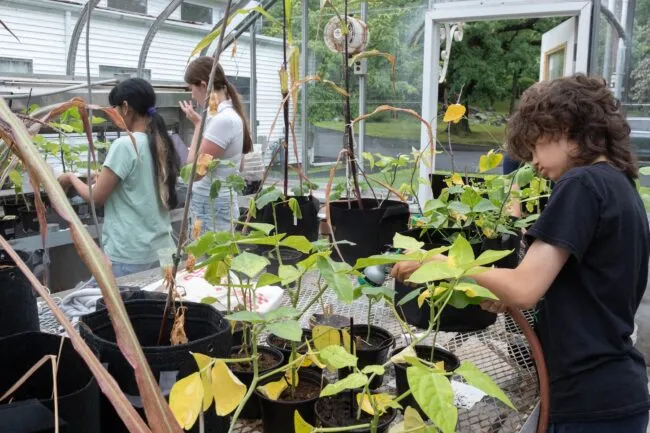
Working in the F4H Living Lab greenhouse on the Lamont campus and supported by F4H researchers and SSFRP undergraduate mentors, high school students learned how research inquiries can support food security in a changing climate by informing climate and agricultural modeling and contributing to practical recommendations—all while designing and conducting their own research project. The team set out to answer the following questions: How do varieties of heat and drought-tolerant crops fare under varying and extreme conditions? Which crops will grow the best under these conditions? How can these findings support evidence-based management recommendations for farmers facing climate-related agricultural challenges?
Over the course of six weeks, the team used the greenhouse’s temperatures and controlled watering to simulate extreme climate conditions on various “opportunity crops”: red corn, lima beans, cowpeas and okra. Opportunity crops are nutritious food crops that have demonstrated resilience in harsh climate conditions such as drought and heat. The team divided the plants into control and treatment groups and monitored plant height and leaf spectrophotometry as indicators of health.
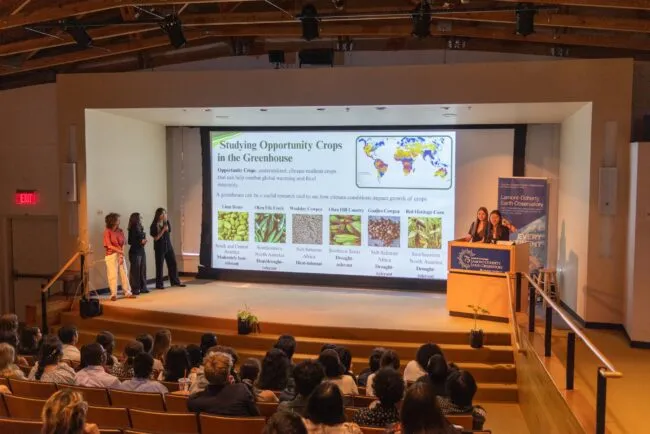
Students found that the crops expected to be drought- or heat-tolerant actually grew best with more generous watering, especially at higher temperatures, and that being drought- or heat-tolerant does not necessarily mean those are the most optimal conditions for plant growth and overall health. The team then reviewed the Intergovernmental Panel on Climate Change’s projected variation in surface air temperature and precipitation for the middle and the end of 21st century to assess which regions around the world could benefit from growing more opportunity crops to help ensure food and nutrition security, even as they face more extreme climate conditions. Along with the rest of their SSFRP cohort, the team presented their results and conclusions at the SSFRP research showcase at Lamont as well as at the NYC Science Research Mentoring Consortium’s Student Research Symposium at the American Museum of Natural History.
Urban Waters Under Pressure: Investigating and Mitigating Urban Algal Blooms
Across the Hudson River, another group of 20 high school students from the tri-state area dove into a more local issue: harmful algal blooms in Morningside Park Pond in Morningside Heights, Manhattan.
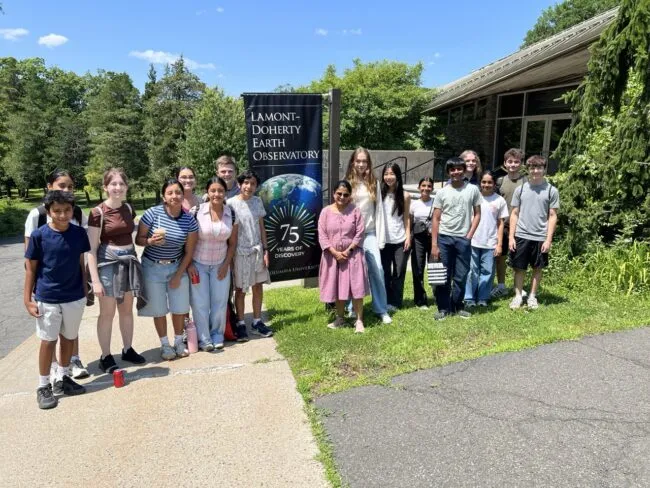
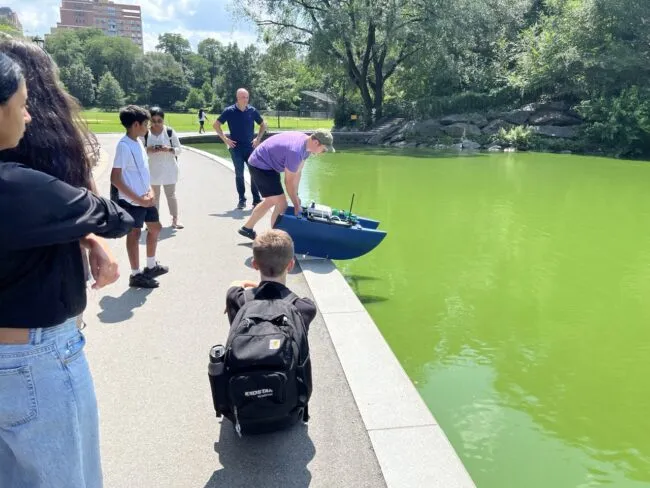
The Climate Education Earth Network partnered with Lamont research professor Joaquim Goes to bring students on a two-day field and laboratory research experience to learn how temperature, nutrient levels, sunlight, water flow, climate change and urban conditions can contribute to ecosystem imbalance and water-quality problems. At Morningside Park, Goes and the New York City Department of Parks and Recreation are studying the pond’s algal blooms to identify strategies for improving freshwater ecosystem health. Students were introduced to the science and harms of algal blooms, collected water samples at the pond and from their own neighborhoods and analyzed them in research labs on the Lamont campus. The group reflected on how environmental data can inform real-world management strategies to improve urban ecosystem health, such as shading, limiting nutrient runoff and increasing water circulation.
For some students, participating in these programs was their first exposure to scientific fieldwork and laboratory analysis. Whether they are already determined to pursue a career in science or just beginning to take an interest in the topic, students expressed appreciation for the opportunities to observe and experience the practical applications of scientific knowledge in real-world settings. By presenting their project progress and outcomes, students also improved on their science communication skills, learning to articulate and convey complex technical information to diverse audiences. These skills are highly transferable to many scientific disciplines and beyond.
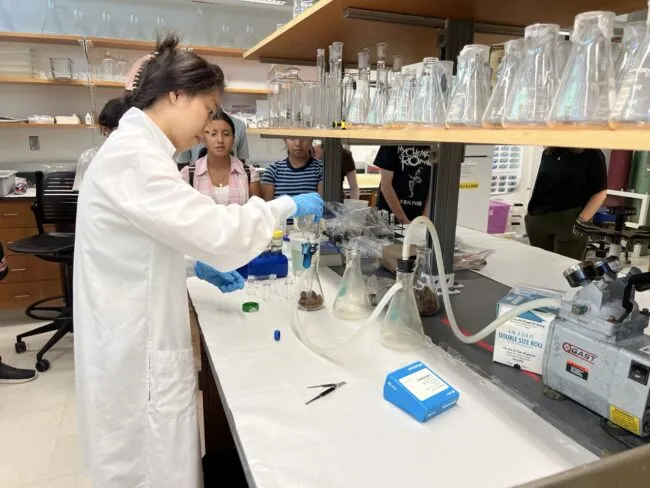
Teaching students about climate and environmental problems alone is not enough. Abstract concepts learned in the classroom become much more tangible when students apply their knowledge in a specific or local context. Student-led research and field-based data collection enable them to understand issues as interconnected systems, and interdisciplinary research shows students that their scientific conclusions can drive real change when they are grounded in a broader understanding of the systems around them. Climate education through inquiry and discovery becomes empowering when paired with the tools, skill sets, real opportunities and a sense of agency that enable learners to begin developing and applying solutions in real time. The next generation of problem-solvers, innovators and changemakers is already here, and they are eager to get started.
The Climate Education for a Resilient Future Earth Network (2023-2026) is a consortium of educators, researchers, practitioners and staff at Columbia University that supports interdisciplinary collaboration across the university and beyond to advance climate education, research, and impact. Network members are united in their mission to co-develop resources and strengthen formal and informal climate education initiatives in communities worldwide to address the urgent need for climate literacy and empowerment. Through events, programs and resources, Columbia University’s research and education are extended to directly reach and support students and teachers in the NYC area and beyond, helping to train and empower the next generation of climate scientists, practitioners and leaders.
Interested in supporting climate education and connecting with our Network members that are doing this work? Join our Earth Network LinkedIn group to stay connected, share resources and help shape the future of climate education.