
The Next Warning Must Reach People Before the Water Does
On September 24, the United Nations General Assembly adopted its first declaration on sea-level rise, affirming that states losing territory to rising seas will keep their statehood and maritime zones. The declaration calls for stronger adaptation, disaster risk reduction, early warning systems and sea-level observation to protect coastal communities from storm surges and flooding.
In preparation for COP31 in Antalya, Türkiye this week, the president of the 81st session of the General Assembly, Khalilur Rahman, foreign minister of Bangladesh, held a special event titled “A Planet Fit for the Future: Restoring Trust Through Climate Action,” which included a panel on “Reimagining Early Warning in an Era of Melting Ice and Rising Seas.” I had the privilege of moderating the afternoon session.
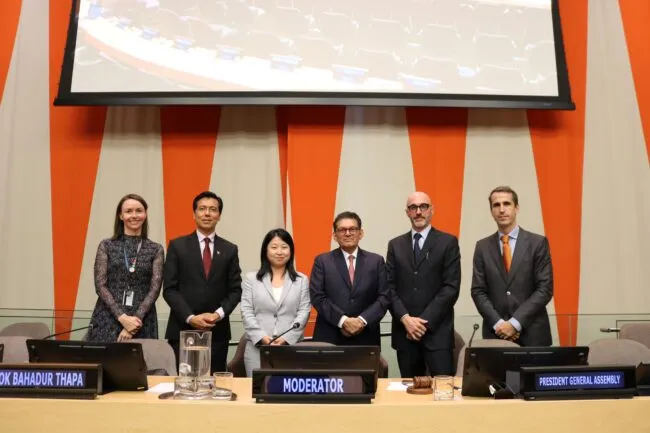
During that session, I reminded the Assembly that, during the four minutes of my introductory remarks, melting ice in Greenland and Antarctica would have poured, on average, the equivalent of about 40,000 swimming pools into the ocean. Over a year, that represents an increase of about 1.1 millimeters in global sea level. One millimeter might not seem like much, but recent studies suggest that every millimeter of sea-level rise can expose 600,000 people to coastal flooding. The world’s mountain glaciers contribute to sea-level rise at roughly the same rate as these two giant ice sheets.
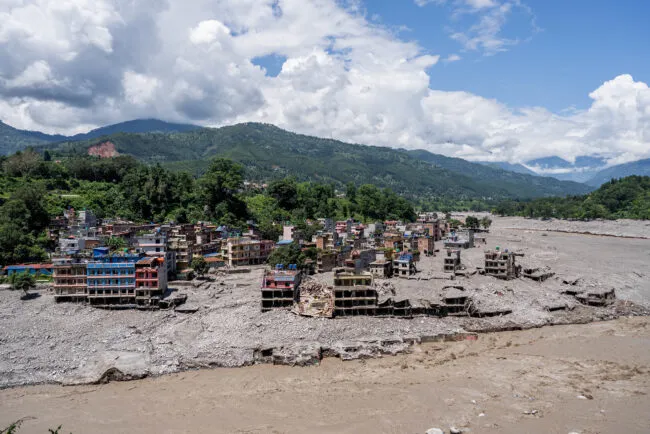
Mountain regions, such as the Himalayas, have no coastline, so we might think they are not part of this narrative. However, a mountain village in the Himalayas and an atoll in the Pacific Ocean are two ends of the same thread that runs through our changing climate and ties every country to the fate of the world’s ice. That thread runs straight through Nepal, a country that unfortunately knows all too well what happens when ice lets go all at once, as the world witnessed in August of this year.
We cannot warn people about what we do not measure. Despite having eyes in the sky, the satellite image showing a missing piece of the glacier came only after the flood had crossed an international border and killed more than 1,400 people, with nearly 6,000 still unaccounted for, devastating villages and reshaping the landscape. Our data means nothing if it stops at a checkpoint, and warnings must cross borders faster than the water does: a forecast that reaches an office but not a person is not a warning. It is a record.
One of the panelists, Laura Paterson, World Meteorological Organization representative and coordinator to the U.N., noted that “in low- and middle-income countries, only half of those [who reportedly received] a warning were able to act” and that “there are 54,000 glaciers across the Hindu Kush Himalayas, and yet only 37 of them have ground-based observation networks.” As Rahman said in his closing remarks: “Early warning saves lives only when people can receive it, trust it and act on it.”
Current early warning systems can be delayed and are not designed to account for compound geophysical effects. These effects are further compounded by social inequalities, financial constraints and political decisions, raising the question of who shapes and receives protection, who can act on a warning, and who is left to bear the losses. As panelist Kamal Kishore, special representative of the U.N. Secretary-General for Disaster Risk Reduction and head of the U.N. Office for Disaster Risk Reduction, noted: “Even in a single event, it’s very difficult to characterize what was the principal hazard. It was not one hazard. It was multiple cascading hazards.” Another panelist, Lok Bahadur Thapa, Nepal’s permanent representative to the U.N., explained that existing warning systems, built around rainfall and river monitoring, “are not designed to detect sudden mountain collapse hazards.” Panelist Jihyea Kim, program manager at the Fund for Responding to Loss and Damage, noted that the Fund’s first call, which closed in June, drew 176 funding requests from 119 countries totaling USD 2.8 billion, and that “the needs countries have put before us far exceed what is currently available.” She also said that 77 of those requests include early warning or preparedness activities.
Science will not hand us certainty. What it can provide is time. Over the next few days, delegates will carry this declaration from New York to Antalya. COP31 is where its words must find financial support for adaptation and loss and damage; early warning systems shared across borders; and emissions cuts deep enough to decide how much ice the next century will inherit. The work ahead is an enormous effort, and it cannot stop at COP31. Much of it will rest on the delegates who attended the event. I wish them courage, patience and perseverance for COP31 and every year after, because the ice will not wait for us to be ready. The next warning must reach people before the water does.
Marco Tedesco is a Lamont research professor at the Lamont-Doherty Earth Observatory, which is part of the Columbia Climate School, and founder and director of the Laboratory on AI, Climate and Society at Columbia University.